

MEDICAL EDUCATION

Educational Efforts Shaping the Future of Women’s Environmental Health

The Collaborative for Women’s Environmental Health’s educational initiatives foster collaboration and engagement among healthcare professionals.
W

hile many cities across the United States faced record-breaking summer heatwaves, Earth experienced its warmest day in recorded history on July 22nd, 2024. As the climate crisis intensifies, the impact of climate change on the environment poses a threat to health. Among pregnant populations, environmental-related hazards are linked to conditions such as low birth weight, preterm birth, eclampsia, and more.

Healthcare professionals are uniquely positioned to support the response to the climate crisis with their training, expertise, and role as health messengers. Informed by this understanding, the Collaborative for Women’s Environmental Health (CWEH) in the Department of Obstetrics and Gynecology at Columbia University Irving Medical Center leads various educational initiatives for professionals in the field of Obstetrics and Gynecology.
“These are the future leaders of medicine, and it is inspiring that sustainability will increasingly be central to their professional roles.”
– Dr. Blair Wylie, Founding Director of CWEH
In efforts to support environmental health education and advocacy, CWEH has launched a graduate medical education (GME) initiative designed to develop expertise in climate change and healthcare sustainability. The two-year program includes didactics around core competencies that health professionals will require to address the climate crisis, as well as interactive dialogues with Columbia climate experts. By focusing on environmental health-related topics that fall outside of existing specialty-specific GME curricula, this initiative adds to the breadth and depth of graduate training programs. The selected inaugural cohort includes two obstetrics and gynecology first-year residents among a larger group of residents and fellows from across the Columbia University Irving Medical Center training programs. Dr. Blair Wylie, Founding Director of CWEH and a Program Director of the GME Initiative reflects on the importance of this educational program; “these are the future leaders of medicine, and it is inspiring that sustainability will increasingly be central to their professional roles.”
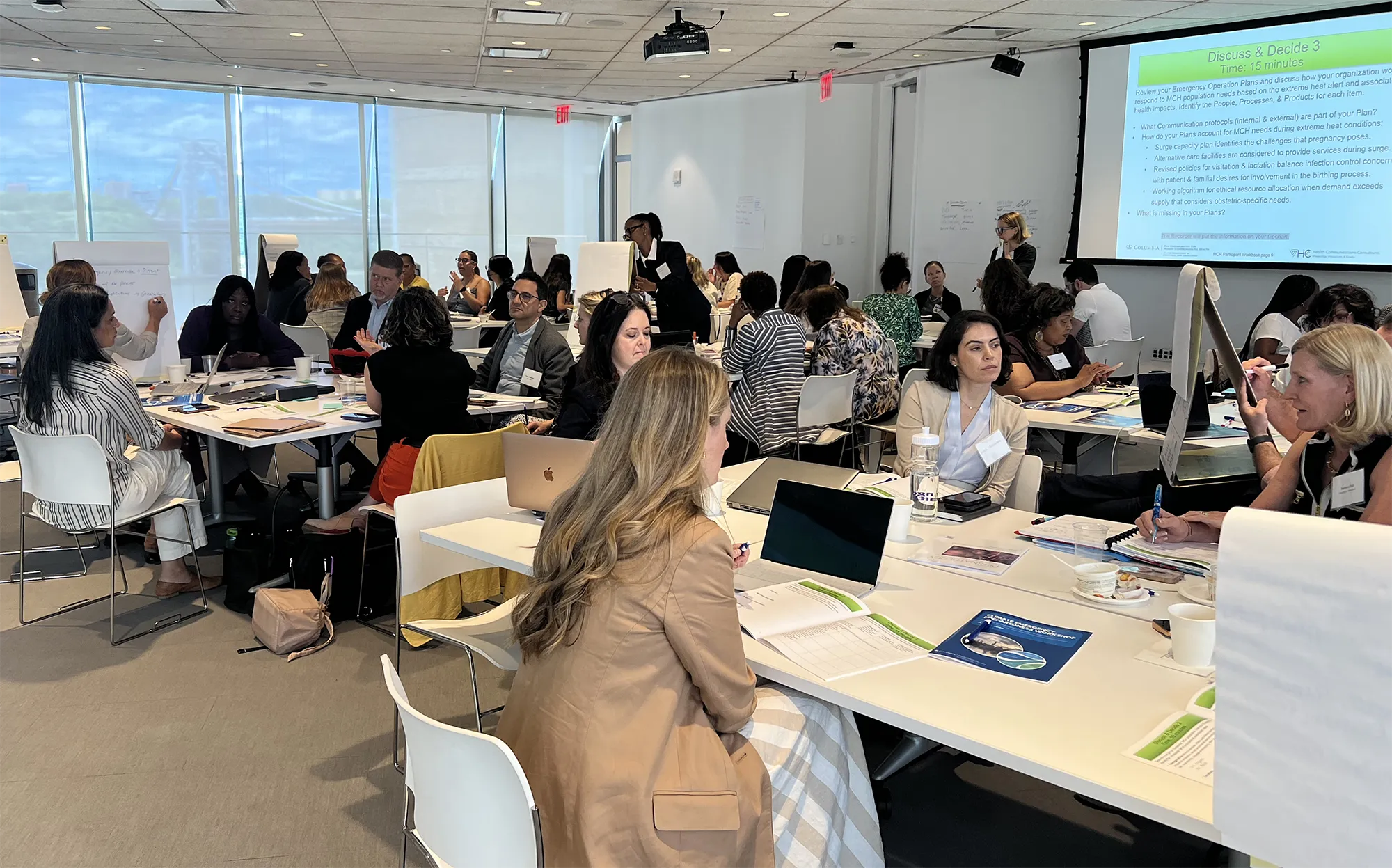
A group of professionals engaged in a workshop in a modern conference room. Participants sit at tables in small groups, discussing and taking notes. The room features large windows with a city view, bright lighting, and two projection screens displaying presentation slides. Flipcharts and laptops are visible on the tables.
Attendees of the Climate Emergency Preparedness Workshop in small group discussions.
In June 2024, CWEH hosted a Climate Emergency Preparedness Workshop for maternal-child health professionals based in the New York City region. This educational event was designed to increase knowledge, preparedness, and resources for supporting maternal-infant health during climate emergencies, including heat waves, extreme weather events, flooding, and wildfire-induced air pollution, as was experienced during the summer of 2023.

With attendees from over 15 hospitals, community-based maternal-child health organizations, and municipal health and emergency management offices, the workshop helped hospitals develop emergency protocols to care for pregnant and newborn populations during climate emergencies. This event marked the beginning of a larger effort to foster collaboration and proactive engagement around climate change and environmental health among healthcare professionals. To support the momentum of this work, workshop attendees were encouraged to continue the dialogue, sharing insights, best practices, and resources to support preparedness and response efforts with their home institutions and organizations.

CWEH’s educational initiatives serve as critical building blocks in the effort to address the climate crisis and mitigate negative environmental health outcomes among vulnerable populations.